



Add as Preferred Source on Google
It is a really thrilling time for you as an international student to move to the United States, but it is also important to stay connected from day one. From calling home back to your family, going through your university campus learning and renting rides over those apps, you need a quality mobile connection.
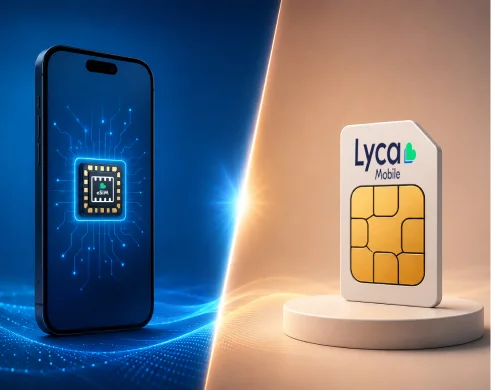
SIM card or eSIM - which is better?
The answer varies - based on your phone, budget and how long you'll be in the U.S.
This guide will go through everything international students need to know before making a choice.
What is a SIM Card?
SIM is a small plastic chip that goes in your phone.
It connects your device to a mobile network enabling you to:
- Make calls
- Send texts
- Use mobile data
- Receive OTPs and verification messages
Standard SIM cards have been around for decades and will work with nearly any mobile phone.
What is an eSIM?
A eSIM (Embedded SIM) is a digital SIM that is fitted directly inside your phone.
It does not require you to insert a plastic card; rather, you just:
- Purchase a plan online
- Receive a QR code
- Scan it
- Activate your mobile service
Your carrier profile is downloaded instantly to your phone.
Modern smartphones, including the latest iPhones, Google Pixel devices, and Samsung Galaxy phones, feature eSIM technology. Many recent U.S. iPhone models are eSIM-only, another sign of the industry transition process.
Comparative Overview of SIM Card vs eSIM
| Feature | Physical SIM | eSIM |
|---|---|---|
| Set up | Insert card | Scan QR Code |
| Activation | Store or delivery | Online in minutes |
| Need to swap SIM? | Yes | No |
| Dual SIM support | Limited | Excellent |
| Lose or damage? | Suggestion | Impossible to lose |
| Great for travelling | Good | Excellent |
| Keep residential SIM active | Difficult | Easy |
| Eco-friendly | No | Yes |
Why International Students Prefer eSIM
Instant Connectivity
You arrive at JFK or LAX, making sure that as few people as possible are able to see your face.
You can set up your mobile data before stepping out of the airport instead of searching for a SIM kiosk.
So many travelers now install eSIMs prior to departure then connect on arrival.
Keep Your Home Number
International students are usually required to hold:
- Banking OTPs
- Family calls
- Government messages
- University verification
Support Dual SIM with which you can:
- Keep your home SIM active
That makes life so much easier for international communication.
No Tiny SIM Cards
Here are some tricky aspects of setting up a physical SIM card:
- Lose
- Damage
- Misplace
Because an eSIM is embedded in your phone, there's nothing to physically remove or swap.
Switch Plans Easily
Need more data?
Just buy another eSIM plan online.
- No waiting.
- No shipping.
- No store visit.
Perfect for Traveling During Breaks
International students often travel during:
- Spring Break
- Thanksgiving
- Winter Holidays
- Summer Vacation
There are many regional eSIM plans that will work in a handful of countries without having to switch out the SIM cards, so if you're visiting Canada, Mexico or even Europe these can often extend further than just one specific nation.
When Does a Physical SIM Card Make More Sense?
Promo Price for 6 Months
$33 High Data Plan
$ 7.50 / 30 days
18 GB Data
- 18GB data at up to 5G speeds
- Unlimited nationwide talk & text
- Unlimited international talk & text to 100 countries
Promo Price for 9 Months
Unlimited Plus
$ 18.00 / 30 days
Unlimited Data
- Unlimited Talk & Text
- Enjoy unlimited data with full-speed access for the first 50GB!
- Includes 15GB of High-Speed Hotspot Data
eSIMs are on the rise, but physical SIM cards still have their benefits.
If any of the following sounds familiar, a physical SIM may work better for you:
- Your phone doesn't support eSIM
- You are running an older model of Android device
- You can transfer your number from one phone to several phones
- Your carrier of choice only provides SIM cards
- You're there for the long haul, and you want the full kit and caboodle
Cost Comparison
Prices vary depending on:
- Data allowance
- Network
- Plan duration
- Promotions
Generally, you'll find:
eSIM
- Quick online activation
- Flexible prepaid plans
- This is perfect for short- and medium-term stays
Physical SIM
- Usually lower long-term unlimited plan prices
- Even better if you require a local number that can be used indefinitely
For students coming to the U.S., eSIM is the quickest and simplest way to get started in most cases, but local physical SIM plans are still worth it for those who plan a longer stay. I will spare you the details now, but the gist of it is this: You cannot hope to build a world map during your travels.
Which Phones Support eSIM?
A good deal of more modern phones are eSIM-equipped, including:
Apple
- iPhone XS and newer
- iPhone 11
- iPhone 12
- iPhone 13
- iPhone 14
- iPhone 15
- iPhone 16
Samsung
- Galaxy S20 and newer
- Galaxy S21
- Galaxy S22
- Galaxy S23
- Galaxy S24
- Galaxy Z Fold and Flip series
- Pixel 3 and newer
- Pixel 4
- Pixel 5
- Pixel 6
- Pixel 7
- Pixel 8
- Pixel 9
Always verify that your exact model is carrier-unlocked before buying an eSIM, as this will not be integrated into every smartphone.
How to Activate an eSIM
The setup typically only requires a few minutes:
- Purchase an eSIM plan
- Receive a QR code
- Open your phone settings
- Add Mobile Plan
- Scan the QR code
- Select the eSIM for cellular data
- Start using your connection
Some providers enable you to complete this all before you even step aboard your flight.
Tips for International Students
Before choosing your mobile plan:
How to know is phone is unlocked
Other carriers: If a phone is locked to its original carrier, it may not work with another carrier's SIM or eSIM.
Estimate your monthly data
Frequent activities requiring additional data with heavy users include:
- Stream Netflix
- Attend Zoom classes
- Use Google Maps
- Watch YouTube
- Play online games
Think About Travel
For those of you who will be visiting several countries during your studies, an eSIM will help you switch more easily between networks.
Keep Your Original Number
Dual SIM allows you to remain in touch with your family and still receive critical verification messages from your home country.
SIM Card vs eSIM: Which one should you pick?
Choose a Physical SIM if:
- Your phone doesn't support eSIM
- You Have a Long stay Planned With A Carrier
- You are a SIM hopping from one device to another
Choose an eSIM if:
- You have a compatible phone
- You want instant activation
- You want your home SIM to be activel
- You travel frequently
- You prefer managing everything digitally
Final Verdict
In a nutshell, for scanners arriving in America steadily, the eSIM is the superior option.
It can be activated instantly, doesn't require you to take a trip to the mobile store, keeps your home number on, and saves you a lot of hassle on overseas trips. Physical SIMs are certainly not dead yet - most notably for older devices or long-duration domestic plans, but eSIMs have quietly made a big dent as the more convenient and flexible option.
If your phone supports eSIM, this is probably the simplest way to hit the ground running when you arrive in the USA.